OpLogica
Reviewability Self-Assessment

Estimate how reviewable your workflow is.

This tool helps you reflect on whether your workflow produces decisions that support later review, reconstruction, and explanation. It is a starting point for thinking, not a formal assessment. It is illustrative and educational, and it is not a Workflow Audit.

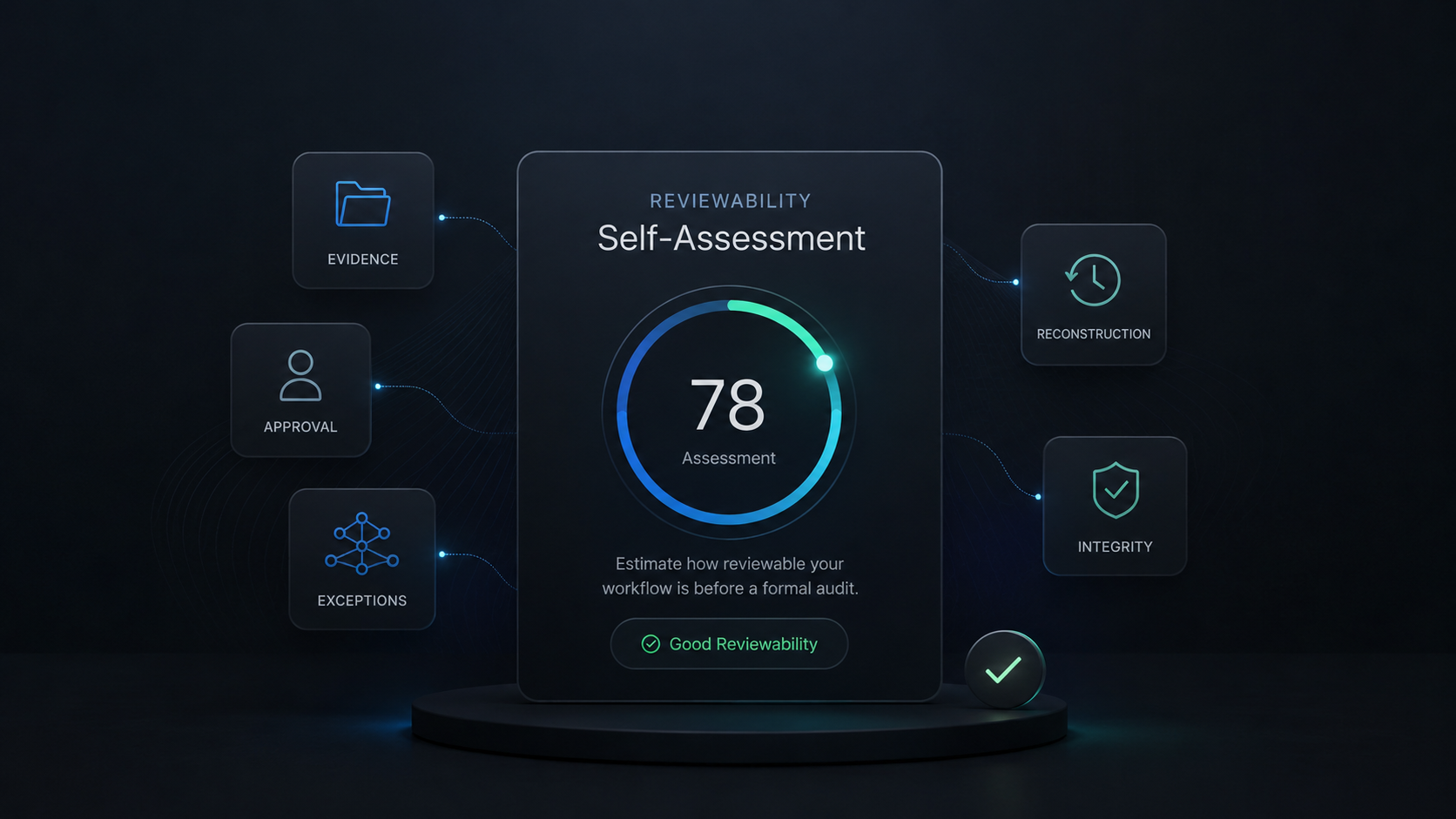
Reviewability self-assessment score with evidence, approval, exceptions, reconstruction, and integrity signals

Who this is for.

A thinking aid for those who want to reflect before an audit.

  • Operators in decision-heavy workflows
  • Executives accountable for risk-sensitive decisions
  • Risk and compliance leaders
  • Reviewers in partially automated or AI-assisted workflows
  • Insurance teams, especially, who want to reflect before an audit

Who this is not for.

This is respect for your time, not a barrier.

  • Workflows with no consequential decisions
  • Those seeking compliance certification or legal validation
  • Those expecting a formal or guaranteed result

How this assessment thinks.

The assessment reflects the same principle as the methodology: a decision is accountable when its evidence, approval, exceptions, record, and reconstruction are present and consistent, governed well. It helps you see where you stand, honestly. It is illustrative, not a measurement engine.

What this estimates.

It estimates reviewability maturity, illustratively, across six domains.

  • Reviewability: can the decision be reviewed after the fact
  • Evidence Integrity: evidence present, retained, and bound to the decision
  • Approval Traceability: approvals carry identity and rationale
  • Exception Visibility: missing or invalid inputs routed and recorded
  • Decision Reconstruction: the decision can be reconstructed from retained records
  • Operational Accountability: ownership is clear across the workflow

What this does not estimate.

  • Whether decisions were correct.
  • Whether the organization is compliant.
  • Whether it meets any legal standard.
  • The quality of outcomes.
  • The security of systems.

The six domains.

These are the same six domains the scoring model assesses and the methodology defines. The questions in each are illustrative reflective prompts, not scored items.

  • Reviewability Can the decision be reviewed after the fact?
  • Evidence Integrity Is evidence present, retained, and bound to the decision?
  • Approval Traceability Do approvals carry identity and rationale?
  • Exception Visibility Are missing or invalid inputs routed and recorded?
  • Decision Reconstruction Can the decision be reconstructed from retained records?
  • Operational Accountability Is ownership clear across the workflow?

The canonical scoring architecture is explained on the scoring model page.

Illustrative

Reflective questions across the six domains.

Reflect on each, considering where your workflow is strong or weak. These are illustrative prompts, not scored items.

Evidence Integrity questions

  1. Is the evidence behind each decision captured at the time of the decision?
  2. Is that evidence stored where it can be found later?
  3. Is the evidence linked to the specific decision it supports?
  4. Can you confirm which version of the evidence was used?
  5. Is the evidence retained for as long as it may be needed?
  6. Is evidence kept in shared systems rather than personal accounts?
  7. Can a reviewer locate the evidence without asking the original person?
  8. Is the evidence in a format that will remain readable over time?
  9. Is there a consistent way evidence is captured across the workflow?
  10. Would the evidence support the decision if questioned months later?

Approval Traceability questions

  1. Is each consequential decision approved by a person?
  2. Is the approver’s identity recorded?
  3. Is the reason for the approval recorded?
  4. Is the approval tied to the specific decision and version?
  5. Is approval explicit rather than assumed from silence?
  6. Are approvals recorded in the system rather than verbally?
  7. Does the approver have the context needed to approve meaningfully?
  8. Is it clear who has authority to approve what?
  9. Is the approval step consistently applied under time pressure?
  10. Could you show who approved a decision if asked later?

Exception Visibility questions

  1. Are exceptions to the normal process recorded when they happen?
  2. Is the reason for each exception captured?
  3. Is the resolution of each exception recorded?
  4. Are recurring exceptions handled consistently?
  5. Are exceptions routed to someone with authority?
  6. Are exceptions handled inside the system of record?
  7. Is it clear when an exception has been resolved?
  8. Can you tell later that an exception occurred at all?
  9. Is the cause of an exception recorded, not just the event?
  10. Could you explain a past exception months later?

Reviewability questions

  1. Does each decision produce a record?
  2. Does the record include the required fields?
  3. Does the record show who created it and when?
  4. Is the record linked to its evidence?
  5. Is the record linked to its approval?
  6. Is the record covered by controls or trails that make later changes easier to detect?
  7. Is there a single authoritative version of the record?
  8. Is the record stored where it can be found?
  9. Does the record capture the reasoning, not just the outcome?
  10. Is there a change trail that would make later edits visible?

Decision Reconstruction questions

  1. Could a past decision be reconstructed from retained records?
  2. Could you do so after the people involved have left?
  3. Could you do so after the workflow has changed?
  4. Can the evidence and the record be matched later?
  5. Can the sequence of steps be reestablished?
  6. Is the reasoning captured somewhere durable?
  7. Does reconstruction depend on tools still in use?
  8. Would reconstruction produce a single consistent story?
  9. Could a new employee follow the decision trail?
  10. Could a simple later question be answered from the records?

Operational Accountability questions

  1. Is there a clear owner for the workflow?
  2. Is it clear who is accountable for decisions in it?
  3. Are roles and authorities documented?
  4. Is there a consistent policy the workflow follows?
  5. Is adherence to that policy visible in the records?
  6. Is the workflow reviewed periodically?
  7. Are changes to the workflow recorded?
  8. Is knowledge about the workflow held in records, not just people?
  9. Is there a way to raise and resolve concerns?
  10. Could governance of the workflow be explained to an outside reviewer?

How the assessment works.

You reflect on the illustrative questions across the six domains, consider where your workflow is strong or weak, and form an illustrative, educational sense of your reviewability maturity, with an honest explanation of what it means and an optional next step. Any result is illustrative and not a Workflow Audit.

Illustrative responses.

Each is a clearly labeled illustrative example using no real organization.

Illustrative
  • Evidence is captured but never linked to decisions, suggesting a binding gap.
  • Approvals happen but are not recorded, suggesting an approval-trail gap.
  • Exceptions are handled in private messages, suggesting an exception-visibility gap.
  • Records exist but can be edited silently, suggesting an integrity gap.
  • Reconstruction depends entirely on one person, suggesting a knowledge-concentration gap.
  • Governance is informal, suggesting an accountability-ownership gap.
  • Evidence, approval, and records are all present and linked, suggesting strong reviewability.
  • Records capture outcomes but not reasoning, suggesting a reasoning gap.
  • Exceptions are routed and recorded consistently, suggesting strong exception handling.
  • Approvals are explicit and tied to versions, suggesting strong approval traceability.
  • The workflow changed and old decisions no longer map, suggesting a reconstruction gap.
  • Evidence is stored in personal accounts, suggesting an availability risk.
  • A clear owner and documented roles exist, suggesting strong governance.
  • Records cannot be confirmed as unaltered, suggesting a tamper-evidence gap.
  • A simple later question cannot be answered, suggesting an overall reconstruction gap.

Understanding your result.

The result is an illustrative, educational indication of reviewability maturity, not a score, grade, certification, or audit outcome. A stronger result suggests decisions are more reconstructable; a weaker result suggests gaps that an audit could examine.

  • An indication, not a score.
  • Self-reported, not verified.
  • Only a Workflow Audit provides an assessed result.

Result bands.

Qualitative and illustrative, self-reported, not measured. There are no numeric thresholds.

  • Early reviewability

    Many decisions would be hard to reconstruct or defend later. An audit could examine where to start.

  • Developing reviewability

    Some structure exists, with notable gaps across domains. An audit could prioritize them.

  • Mature reviewability

    Decision records appear to support stronger reviewability and reconstruction readiness. An audit could assess and find the remaining edges.

Signs of strong reviewability.

  • Evidence is captured at the moment of the decision.
  • Evidence is bound to the specific decision.
  • Approvals are explicit and recorded.
  • Approver identity and rationale are captured.
  • Exceptions are recorded with their reasons.
  • Exceptions are resolved and the resolution is noted.
  • Records include required fields and timestamps.
  • Records have controls or trails that make later changes easier to detect.
  • There is a single authoritative version of each record.
  • Records capture reasoning, not just outcomes.
  • Decision records support later reconstruction.
  • Reconstruction is less dependent on staff memory or unchanged workflows.
  • The workflow has a clear owner.
  • Roles and authorities are documented.
  • Adherence to policy is visible in the records.

Signs of reviewability gaps.

  • Evidence is not captured at the time of the decision.
  • Evidence is not linked to the decision.
  • Approvals are not recorded.
  • Approver identity or rationale is missing.
  • Exceptions are handled outside the system of record.
  • Exceptions are closed without explanation.
  • Records are missing required fields.
  • Records can be edited without a trail.
  • Conflicting versions of records exist.
  • Records capture outcomes but not reasoning.
  • Decisions cannot be reconstructed from retained records.
  • Reconstruction depends on specific people.
  • The workflow has no clear owner.
  • Roles and authorities are undocumented.
  • Policy adherence is not visible in the records.

Gaps are framed without blame. A reviewability gap is not evidence of misconduct.

Common reviewability gaps.

Recurring patterns the assessment helps you notice, across the six domains: evidence that is not bound to decisions, approvals that are not recorded, exceptions handled off the record, editable records, reconstruction that depends on specific people, and unclear ownership. These are patterns to examine, not verdicts.

See the Decision Failure Gallery

What to do next.

If the assessment surfaced gaps you want examined, the natural next step is a Workflow Audit, which assesses one workflow formally and produces an assessed result. There is no obligation, and you can also read the methodology, the thesis, or a sample report first.

How this differs from a Workflow Audit.

This tool is a self-reported, illustrative reflection. A Workflow Audit is a formal, assessed engagement that examines the workflow, scores it against explicit anchors, and produces a premium report. The tool is a starting point; the audit is the real assessment.

See the Workflow Audit

Assessment questions, answered.

What is this assessment?

An illustrative, educational tool that helps you estimate how reviewable your workflow is today. It is not a Workflow Audit.

Is this a Workflow Audit?

No. It is a self-reported, illustrative reflection. A Workflow Audit is a formal, assessed engagement that produces a premium report.

Is this compliance validation?

No. It is not compliance validation or regulatory approval.

Is this certification?

No. The assessment does not certify anything.

Is this legal advice?

No. It is not legal advice.

Does this guarantee anything?

No. It is illustrative and educational, and guarantees no result or outcome.

What does it measure?

Illustratively, the presence and consistency of evidence, approval, exception handling, records, reconstruction capability, and governance in your workflow.

What does it not measure?

Whether decisions were correct, whether you are compliant, whether you meet a legal standard, the quality of outcomes, or the security of systems.

How accurate is the result?

It reflects your own reflection, not a verified assessment. Only a Workflow Audit provides an assessed result.

What are the six domains?

Reviewability, evidence integrity, approval traceability, exception visibility, decision reconstruction, and operational accountability, the same six our methodology and scoring model use.

Why these six domains?

Because they are the dimensions that determine whether a decision can support later review, reconstruction, and explanation.

How long does it take?

It is designed to be a short reflection across the six domains.

Is my input stored?

The page specifies the experience, not the implementation. Any data handling follows our Privacy Policy, and public materials use fictional data only.

Is this scored by an algorithm?

This specification implements no scoring algorithm. Any result is an illustrative, qualitative reflection, not a computed score.

What is a result band?

A qualitative, illustrative indication such as early, developing, or mature reviewability. It is self-reported, not measured.

Are there numeric thresholds?

No. The bands are qualitative and illustrative, with no numeric formula.

What does a strong result mean?

It suggests your decisions are more reconstructable. It is still self-reported and not a verified assessment.

What does a weak result mean?

It suggests gaps that a Workflow Audit could examine. It is not a verdict or a finding of fault.

Does a weak result mean we did something wrong?

No. A reviewability gap is not evidence of misconduct. Many gaps occur with good people and good intentions.

What should I do after the assessment?

If it surfaced gaps you want examined, a Workflow Audit is the next step, with no obligation. You can also read the methodology, the thesis, or a sample report.

Is there any obligation to request an audit?

No. The assessment is free and carries no obligation.

How is this different from the audit?

The tool is a self-reported, illustrative reflection. The audit is a formal, assessed engagement with a premium report.

Can I use this with my team?

Yes. It can be a useful prompt for a team conversation about reviewability.

Does this connect to your products?

It reflects the same six domains the Workflow Audit assesses and the scoring model explains.

Are the sample responses real?

No. They are clearly labeled illustrative examples, with no real organization.

Is this exhaustive?

No. The questions are a representative, illustrative set, not a complete catalog.

Why do you offer this for free?

To help visitors think clearly about reviewability before deciding whether an audit is right for them.

Will my result be shared?

No. The assessment is for your own reflection.

Can this replace an audit?

No. It is a starting point. Only a Workflow Audit provides an assessed result.

Does a strong result mean I do not need an audit?

Not necessarily. The result is self-reported. An audit verifies and examines in depth.

Is this specific to insurance?

The domains apply broadly, and our first focus is insurance, where the audit is most developed.

Do you store my workflow details from this tool?

Public materials use fictional data only, and any data handling follows our Privacy Policy.

Is the result a compliance score?

No. It is not a compliance score, grade, or certification.

Where can I learn the full method?

On the methodology and scoring model pages, with the deliverable shown on the sample report page.

How do I start a Workflow Audit?

Through the Request Audit page, which explains the process and carries no obligation at submission.

Is this assessment a measurement engine?

No. It is an illustrative reflection aid, not a measurement engine, and this specification implements no scoring logic.

Start your audit

A starting point, not a verdict.

This assessment is a way to start thinking about reviewability, not a verdict on your workflow. If it surfaced gaps you want examined, a Workflow Audit is the next step, with no obligation.