Start your Workflow Audit.
You have seen what the audit is and what it produces. This is where you begin. Below is what typically happens after you submit, with no pressure and no commitment to purchase.
Submitting starts a conversation, not a purchase.
Start your Workflow Audit. Submitting starts a conversation, not a purchase. After a short discovery conversation, we agree on scope, tier, and price together. Before we begin, you confirm you have read what OpLogica does and does not do, and we send a payment link or invoice for the agreed scope. Then we run the audit and deliver your report and written review notes, with an optional review session if needed. No obligation at submission, and no open-ended consulting.
Why start with an audit.
The audit gives a clear, executive-level picture of whether your decision records support review, reconstruction, and later explanation, and a concrete next step.
- A clear picture of where you stand.
- A prioritized view of the gaps that matter most.
- A concrete next step.
Who the audit is for.
Teams that make consequential decisions in risk-sensitive, partially automated, or AI-assisted workflows with human approval, especially in insurance.
- AI and automation vendors selling into regulated sectors
- Risk-sensitive workflows
- Decision-heavy workflows
- Partially automated workflows
- AI-assisted workflows
- Human approval involved
- Evidence sources exist
- Meaningful consequences if wrong
- Insurance workflows especially
Who the audit is not for.
This is respect for your time, not a barrier. The audit is not the right step if you are in one of these situations right now.
- Workflows with no consequential decisions
- Those seeking compliance certification
- Those seeking legal advice or sign off
- Those wanting automation built
- Those expecting a guaranteed outcome
What happens after you submit.
The steps, end to end. Submitting is not a purchase, and there is no obligation to proceed.
- Submit You submit a short request.
- Discovery We reply to schedule a short discovery conversation.
- Scope We agree on scope, tier, and price together.
- Confirm & pay You confirm scope and what OpLogica does and does not do; we send a payment link or invoice.
- Audit We run the audit using the published methodology.
- Report We deliver the report and written review notes, with an optional review session if needed.
No purchase or obligation at submission.
Before you request.
Need the commercial model first? Review these buyer-facing PDFs.
-
 PDF
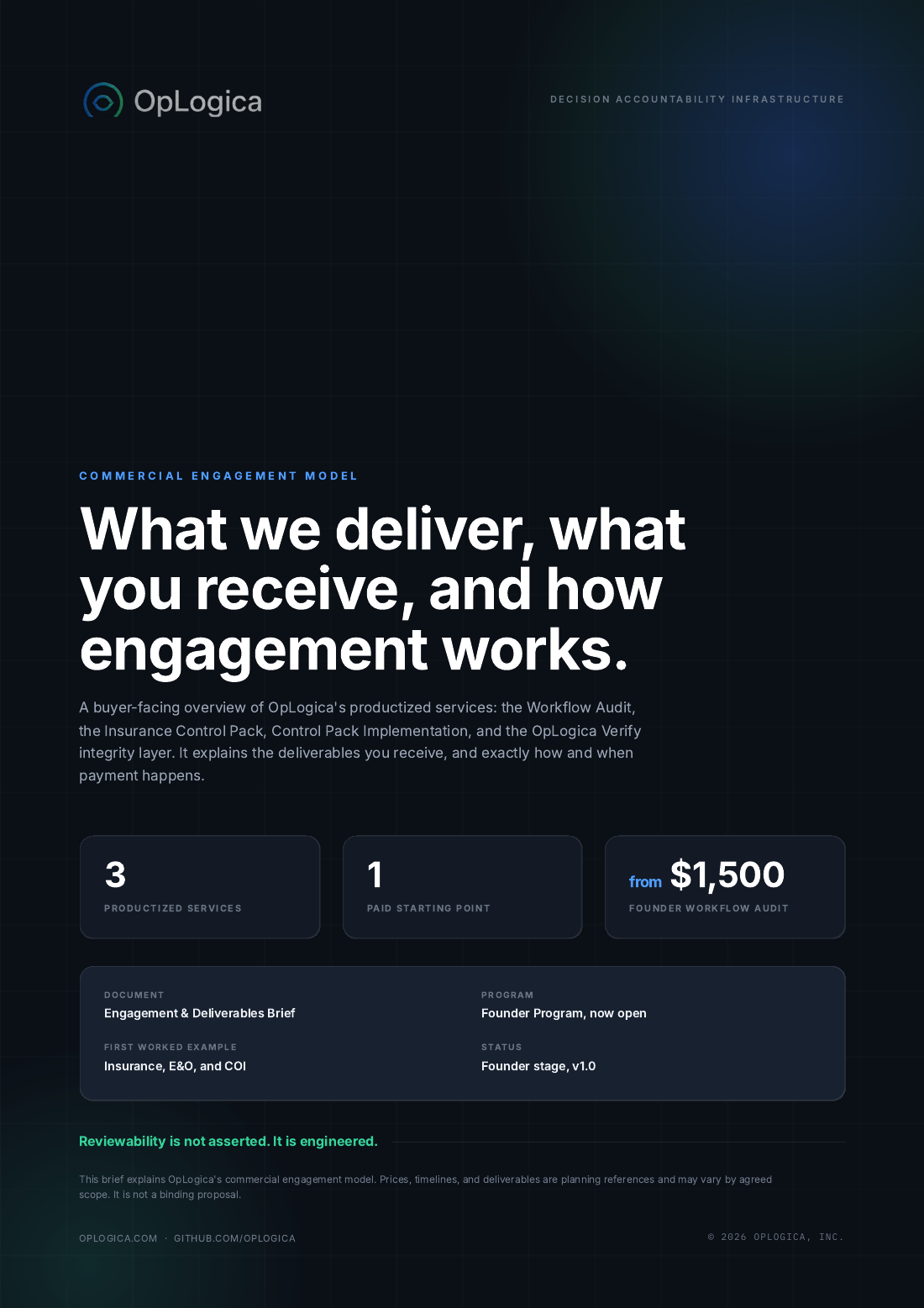
PDF Engagement and Deliverables Brief
Understand what OpLogica sells, what you receive, and how engagement works.
-
 PDF
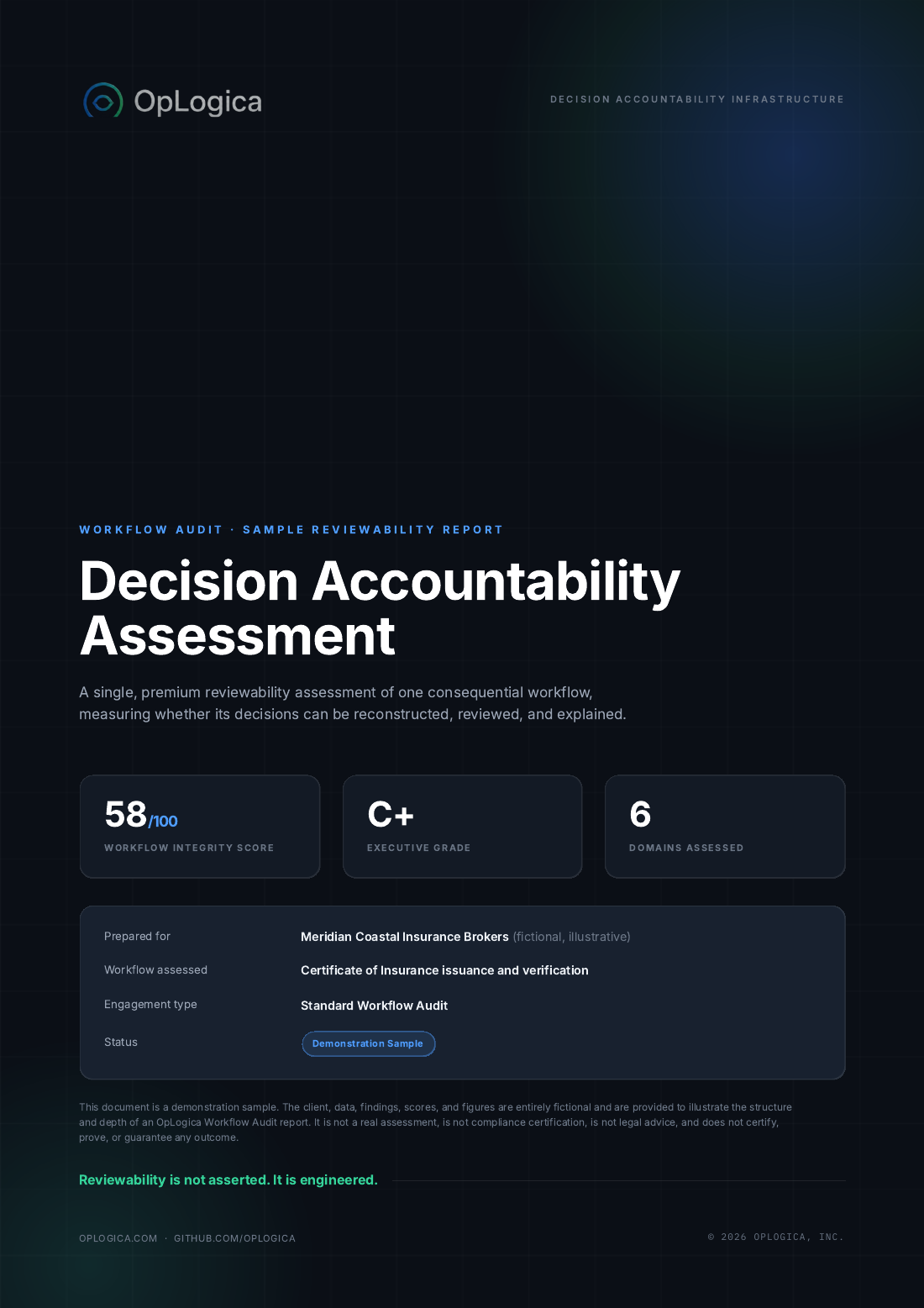
PDF Sample Workflow Audit Report
See the structure of a fictional Workflow Audit report before requesting an audit.
A short discovery conversation.
The first step after submission is a short conversation to understand the workflow, confirm fit, and answer questions. It is consultative, not a sales push, and it helps both sides decide whether to proceed.
- Your workflow
- Whether it is a fit
- Your questions
- The next steps
Defining the scope together.
After discovery, the scope is defined clearly. The scope is fixed and agreed before any commitment, which prevents open-ended consulting.
- The single workflow
- The decision points
- The tier and price
- The timeline
How the audit is delivered.
OpLogica conducts the audit using the published methodology: workflow review, evidence and approval assessment, scoring against explicit anchors, and report generation, followed by written review notes, with an optional review session if needed.
- Review
- Assess
- Score
- Report
- Written notes, with an optional review session if needed
What you receive.
A premium reviewability report, plus written review notes, with an optional review session if needed.
- Workflow Integrity Score
- Executive Grade
- Decision Accountability Map
- Evidence, approval, exception, and reconstruction reviews
- Operational Exposure Estimate
- Recommended Control Pack
- Written review notes, with an optional review session if needed
The exposure figure is a planning estimate. No guarantees.
Typical timelines.
After the discovery conversation and scope, the audit itself typically takes a small number of business days, confirmed at scoping, depending on workflow complexity.
- Discovery conversation.
- Scope agreed.
- Audit in a few business days.
- Report and written review notes, with an optional review session if needed.
What we will need from you.
The initial request is short. Fuller detail is gathered during discovery and scope.
- A brief workflow description
- Your contact details
- The workflow area
- Systems involved
- Decision points
- Evidence sources
- Approval and exception processes
- Estimated decision volume
- Optional documents
Your inputs remain private, and any sample materials we show are fictional.
Confidentiality and privacy.
Public materials use fictional demonstration data only. We describe our practice plainly, without legal or compliance claims.
- Your information is handled as private.
- It is used to assess and deliver the audit.
- Confidentiality terms can be arranged on request.
Questions before you start.
What happens right after I submit?
We reply to arrange a short discovery conversation. Submitting starts a conversation, not a purchase, and there is no obligation to proceed.
Is submitting a request a purchase?
No. It begins a discovery conversation. You decide whether to proceed after the scope is agreed.
Will I be pushed by sales?
No. The discovery conversation is consultative, focused on understanding your workflow and confirming fit.
How much of my time will it take?
A short discovery conversation, a brief scope agreement, and the information we request. The audit itself is conducted by OpLogica.
Is the engagement bounded?
Yes. The scope is fixed and agreed before any commitment, which prevents open-ended consulting.
How do I know if my workflow is a fit?
The who-it-is-for and who-it-is-not-for sections above help you confirm. We also confirm fit during discovery.
What if my workflow is not a fit?
We will tell you honestly. We would rather decline than take on a poor fit.
What do I need to provide to start?
A brief workflow description, your contact details, and the workflow area. Fuller detail is gathered during discovery and scope.
Is my information handled as private?
Yes. It is used to assess and deliver the audit, and public materials use fictional demonstration data only.
Can we put confidentiality terms in place?
Yes. Confidentiality terms can be arranged on request.
What does the audit cost?
Founder pricing is $1,500, the standard audit is from $3,500, and enterprise scope is quoted on request. The tier and price are confirmed at scope.
What do I receive?
A premium reviewability report with the integrity score, executive grade, decision accountability map, evidence, approval, exception, and reconstruction reviews, an operational exposure estimate, and a recommended control pack, plus written review notes, with an optional review session if needed.
How long does it take?
After discovery and scope, the audit timing is confirmed at scoping based on workflow complexity.
Is this compliance certification?
No. The audit supports audit readiness and decision accountability. It does not certify compliance or provide regulatory approval.
Is this legal advice?
No. It is not legal advice and not a replacement for internal audit or counsel.
Do you guarantee a result?
No. The audit produces a clear assessment and a recommended next step. It does not guarantee outcomes, and the exposure figure is a planning estimate.
Do you implement automation?
No. The audit is an assessment. Implementation is a separate, optional engagement.
What happens after the audit?
You receive the report and written review notes, with an optional review session if needed. If the fit is strong, the recommended next step is a control pack, with a 50 percent audit credit if you proceed within 30 days.
Can I see the deliverable first?
Yes. The sample report shows the full deliverable on fictional data, and the scoring model page explains the score.
Do you work outside insurance?
Insurance is our first focus. We can assess one bounded workflow in another area when the fit is strong, but we do not promise coverage we have not built.
Are you an established company?
We are founder-led and early stage, by design, and honest about it. Our credibility comes from transparent methods and inspectable materials.
Why should I trust an early-stage company with this?
Because engagements are bounded and fixed-scope, the methods are transparent, you can inspect the sample and scoring model today, and you own your workflow throughout.
Can we request enterprise terms?
Yes. Enterprise scope is quoted on request after a short qualification.
What am I committing to by submitting?
Only a conversation. There is no purchase or obligation at submission.
Ready to start?
If your workflow is a fit, submit a request and we will set up a short discovery conversation.
No purchase, no obligation, just a conversation.