Find out whether your decisions can stand up to review.
The OpLogica Workflow Audit is a productized assessment of one important decision workflow. You receive a premium report showing whether the decisions in that workflow can be reviewed, reconstructed, and explained later, with a clear recommended next step. It is fixed-scope and paid once. It is not a compliance certification, not legal advice, and not a guarantee of any outcome. Founder pricing is available now.
- One workflow, assessed end to end.
- A premium reviewability report.
- Built on the OpLogica Workflow Audit Framework.
- Founder price: $1,500.
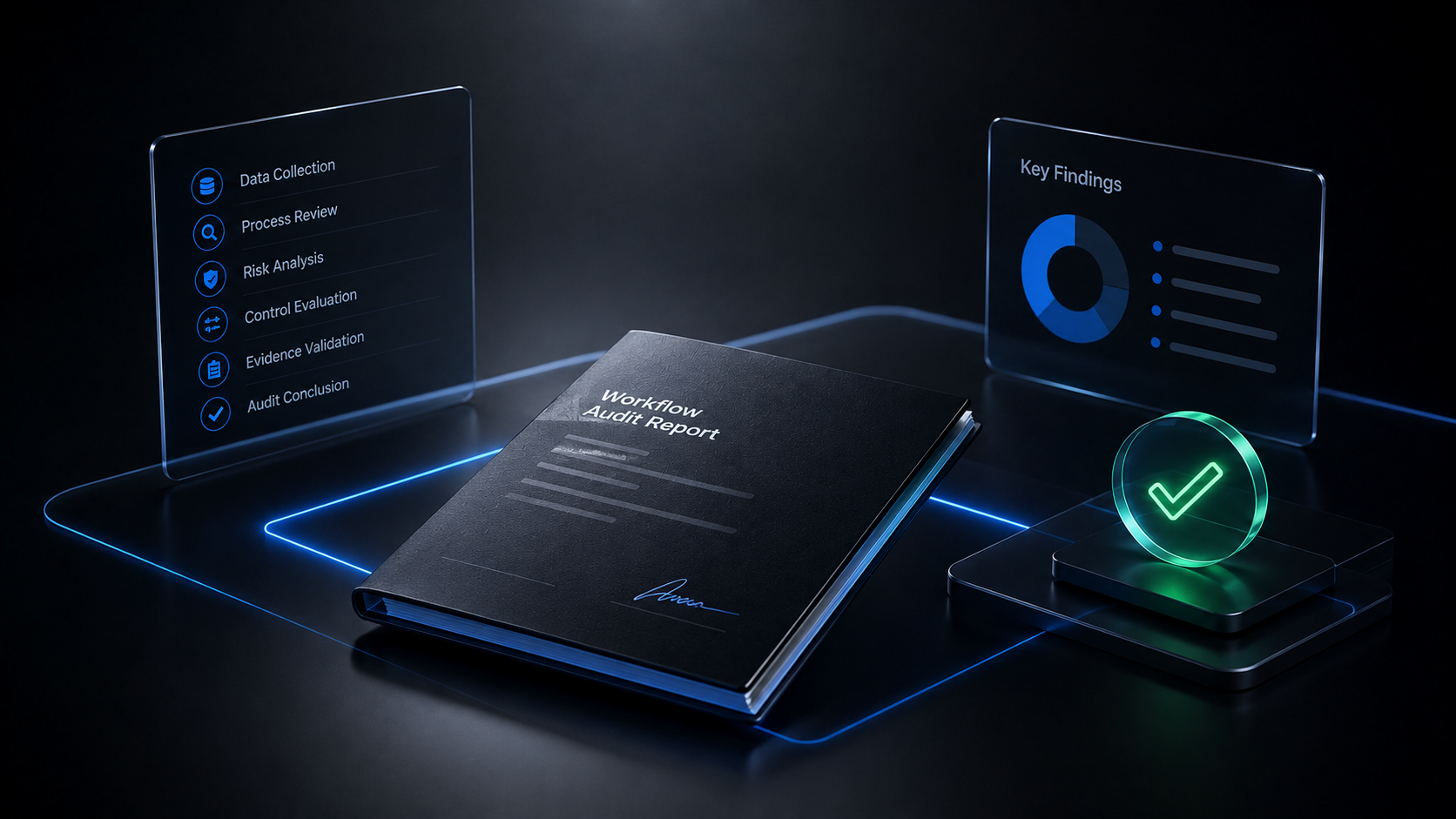
Important decisions happen. They cannot always be reconstructed.
As more of your operations are automated or AI-assisted, decisions are made quickly and recorded thinly. Months later, when a decision is questioned, the evidence, the approval, and the reasoning may not be reconstructable. The audit assesses how exposed one workflow is to that problem.
- Who approved it?
- Which evidence supported it?
- Can the decision be reconstructed today?
- Would the record survive internal review?
The lifecycle of a decision you can review and explain.
Every important decision moves through six stages. The Workflow Audit checks each one. When a stage is weak or missing, the whole decision becomes harder to review and explain later.
- Decision An action is proposed or taken. If the decision point is not identified, later review becomes difficult.
- Evidence The supporting evidence is captured. Without it, the decision rests on memory and cannot be reconstructed.
- Approval A human approves with identity and rationale. Without a recorded approver, accountability is unclear.
- Exception Missing or invalid inputs are routed to a person. Without exception handling, incomplete inputs may pass through unnoticed.
- Record A structured decision record is created with an integrity trail. Without it, later changes may be difficult to detect.
- Reconstruction The decision can be reconstructed from retained records. Without this, the decision is harder to review later.
Questions you should be able to answer.
For any important decision in your workflow, could your team answer these today? The audit assesses how many of these questions your current records can answer.
- Who approved this decision?
- What evidence was used?
- Can this decision be reconstructed today?
- Would the record survive internal review?
- Would a reviewer understand how the decision was reached?
- Were all required approvals captured?
- Where is the evidence stored, and is it still there?
- How was an exception handled, and by whom?
- Has the record been changed since it was created?
- Could you explain this decision to an auditor or a partner?
- If the approver left, would the approval rationale still be clear?
- How long will the records support reconstruction?
What you receive.
The Workflow Audit produces one executive-ready report and written review notes. A live review session is optional if needed. The report scores the workflow, maps decision accountability, and estimates operational exposure, with a clear recommended next step.
- Premium Reviewability Report
- Workflow Integrity Score
- Executive Grade
- Decision Accountability Map
- Evidence Integrity Snapshot
- Approval Coverage Review
- Exception Readiness Review
- Reconstruction Readiness Review
- Operational Exposure Estimate
- Recommended Next Step
- Written review notes, with an optional review session if needed
The exposure figure is an operational planning estimate, not a loss prediction. The grade and score summarize reviewability posture, not compliance.
Buyer assets
Review the engagement model and a fictional sample report before requesting an audit.
-
 PDF
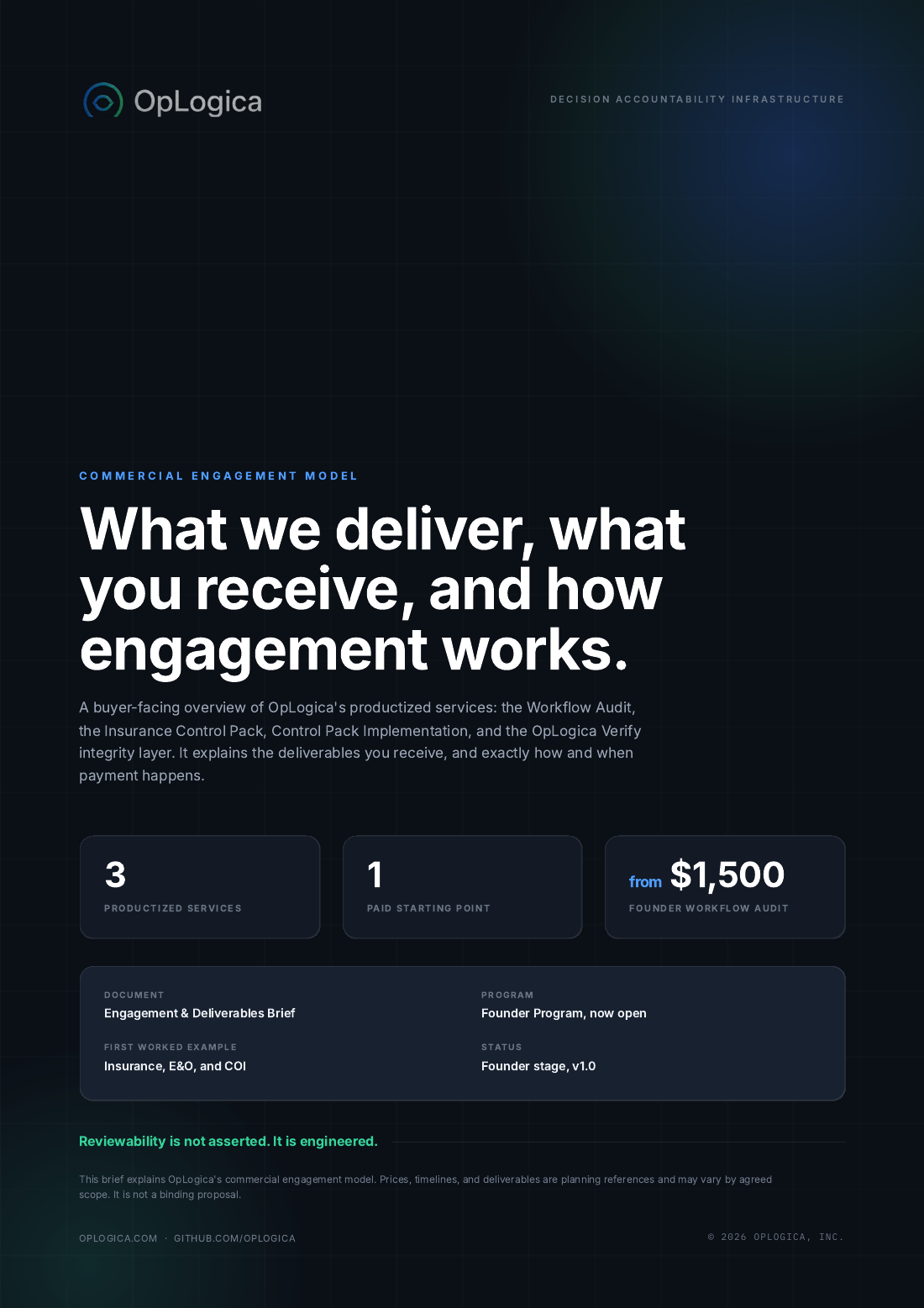
PDF Engagement and Deliverables Brief
Understand what OpLogica sells, what you receive, and how engagement works.
-
 PDF
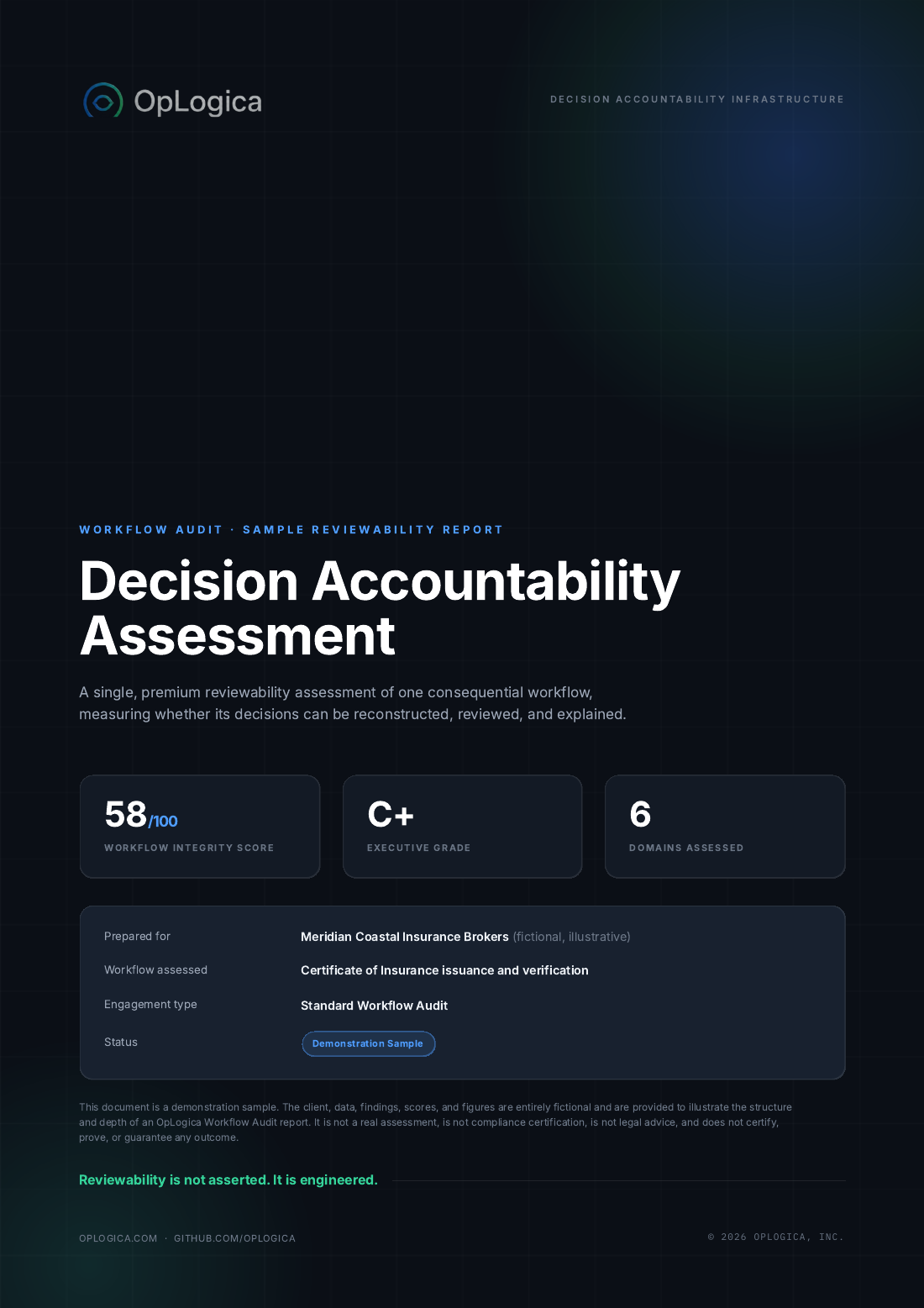
PDF Sample Workflow Audit Report
See the structure of a fictional Workflow Audit report before requesting an audit.
Data and access boundaries
The Workflow Audit is designed to begin without access to your production systems. In most cases, it starts from a workflow description, the systems involved, evidence-source and approval-process descriptions, and optional documentation, diagrams, schemas, or anonymized sample outputs. Live personal or customer data should not be shared unless it is explicitly scoped and agreed in advance. Any additional materials are requested only within the agreed scope, and engagement materials are treated as private.
Assessment, not installation.
The Workflow Audit is an assessment, not an installation. It assesses whether your current workflow can support reviewable and reconstructable decision records; it does not create production records in your systems. Where gaps exist, an Insurance Control Pack and Control Pack Implementation define how those records can be created, and OpLogica Verify is the integrity layer that supports them.
Start with one workflow. We confirm scope before payment.
Review the sample report before you start.
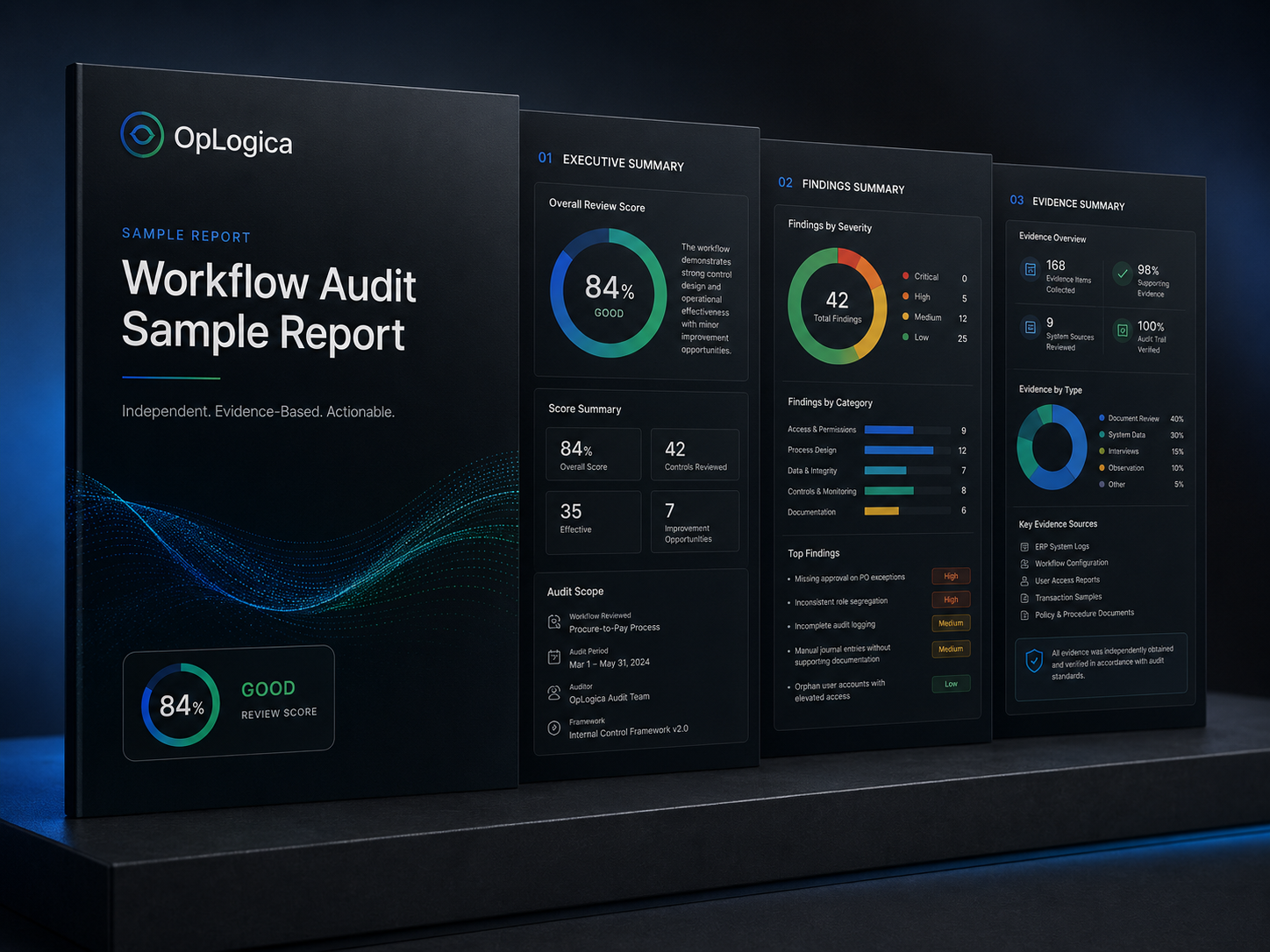
Explore a complete OpLogica Workflow Audit report. It is a demonstration sample built on fictional data, prepared to show the structure and level of detail you receive.
- A complete report layout.
- Fictional, clearly labeled data.
- Every section you will receive.
Scored categories, explicit anchors.
Every audit uses the same method: a set of scored categories, each with clear 0, 1, and 2 anchors, an explicit scope, and stated limitations. No black-box scoring, and no grading without stated anchors.
- Six scored categories.
- 0, 1, 2 anchors per item.
- Explicit scope and limitations.
- Structured and repeatable.
| Domain | 0 Absent or not evident | 1 Partial or inconsistent | 2 Present and consistent |
|---|---|---|---|
| Reviewability | |||
| Evidence Integrity | |||
| Approval Traceability | |||
| Exception Visibility | |||
| Decision Reconstruction | |||
| Operational Accountability |
Automation moves fast. Reviewability keeps it reviewable.
Four related ideas are often confused. OpLogica is about the third and fourth.
- Automation
- Getting the work done. It answers: did the system complete the task?
- Auditability
- Being able to inspect what a system did at a technical level. Useful, but not the same as a reviewable business decision.
- Reviewability
- Being able to review an important decision after the fact: the evidence, the approval, the exceptions, and the reasoning.
- Decision Accountability
- Owning the decision through a record that is reviewable, reconstructable, and explainable.
Reviewability sits between execution and governance. Automation executes. Governance sets the rules. Reviewability is what makes each decision reviewable in between.
A clear, bounded process.
From request to recommendation, the audit follows the same bounded steps, delivered by OpLogica.
- Request audit
- Intake
- Workflow review
- Evidence and approval assessment
- Report generation
- Written notes, with an optional review session if needed
- Recommended next step
What we need from you.
A focused set of inputs lets us assess one workflow clearly. Most clients can provide these in a short intake.
- Workflow description
- Systems involved
- Decision points
- Evidence sources
- Approval process
- Exception process
- Estimated decision volume
- Optional: screenshots or documents
Your inputs are treated as private audit materials, and any sample materials we show are fictional.
How the audit scores your workflow.
The audit produces a clear set of outputs. The benchmark is a transparent reference, not a market claim, and the exposure figure is an operational planning estimate.
- Score: 0 to 100 Workflow Integrity Score.
- Exposure level: derived from the score and key gaps.
- Executive Grade: a single summary letter.
- Benchmark preview: a transparent reference, not a market average.
- Exposure estimate: an operational planning estimate, not a loss prediction.
- Recommended next step: the best-fit action based on the audit findings.
Example findings a Workflow Audit can surface.
These are illustrative examples of the kinds of findings an audit can surface in a workflow. They are general patterns, not claims about any organization.
| Finding | Area | Impact |
|---|---|---|
| Approval exists but is not linked to evidence | A sign off is recorded, but not tied to the documents behind it | Decisions that are hard to justify under review |
| Exception handling occurs through email | Edge cases are resolved in inboxes, not in the workflow | Lost context and inconsistent handling |
| Decision records are incomplete | Key fields or steps are missing from the record | Gaps surface when a decision is questioned |
| Workflow may be difficult to reconstruct after 90 days | The trail fades as systems change or data ages | Inability to explain past decisions |
| Approver identity is not captured | The record shows that someone approved, not who | Difficulty assigning ownership |
| Evidence is referenced but not retained | The record points to evidence that no longer exists | Decisions resting on missing inputs |
| AI output is accepted without a recorded human check | A model recommendation becomes the decision with no sign off | Unreviewed automated decisions |
| Rationale is not recorded | The decision is captured, but not the reasoning | Decisions that look arbitrary in hindsight |
| Records are editable without a change trail | Later edits leave no trace | Changes that may be difficult to detect |
| Exceptions are closed without resolution notes | An exception is marked done with no explanation | Repeat issues and unclear precedent |
Simple, fixed pricing.
Pay once. No subscription. Choose the tier that fits your scope.
-
Founder Audit
$1,500
Early adopters, one bounded workflow
- Full assessment
- Premium reviewability report
- Written notes, with an optional review session if needed
- Recommended next step
- Implementation
- Ongoing monitoring
-
Standard Audit
from $3,500
A standard workflow assessment
- Full assessment
- Premium reviewability report
- Written notes, with an optional review session if needed
- Recommended next step
- Implementation
- Ongoing monitoring
-
Enterprise Audit
Request a quote
Multiple or complex workflows, custom scope
- Custom scope
- No subscription. No seat pricing. Pay once per defined engagement.
All tiers include a full assessment, the premium report, written review notes, with an optional review session if needed, and a recommended next step. They do not include implementation or ongoing monitoring, which are separate. If you proceed to implementation within 30 days, 50 percent of the audit fee is credited toward the implementation fee. No ROI or loss-reduction promises.
What the audit is not.
To be clear about scope, the Workflow Audit is deliberately bounded.
- Not a compliance certification.
- Not legal advice.
- Not a guarantee of risk reduction.
- Not SaaS, and not a subscription.
- Not automation implementation.
- Not a replacement for internal audit or counsel.
Where the audit fits best.
The audit is most valuable for workflows where decisions carry consequences and are made with a mix of automation and human approval.
- Risk-sensitive
- Decision-heavy
- Partially automated
- AI-assisted
- Human approval involved
- Evidence sources exist
- Real consequences if wrong
Who the audit is for.
If your team makes consequential decisions with a mix of automation and human approval, the audit is built for you. Find your role below.
- AI and Automation Vendors AI and automation vendors selling into regulated sectors. You are asked to prove your AI-assisted decisions are reviewable and reconstructable, by enterprise customers and by your insurers. The audit assesses one decision workflow your product supports and produces a structured report you can share.
- Insurance Operations Runs day-to-day certificate and policy operations. The audit assesses whether operational decisions are reviewable and recorded. Typical gap: decisions recorded thinly, hard to reconstruct later.
- Claims Teams Approve, deny, and route claims. The audit checks evidence binding and exception handling on claim decisions. Typical gap: denials or approvals without linked evidence or routing.
- Underwriting Teams Make risk acceptance and pricing decisions. The audit reviews approval traceability and reconstruction readiness. Typical gap: rationale not recorded with the decision.
- Certificate Processing Teams Issue COIs and endorsements at volume. The audit examines approval coverage on high-volume issuance. Typical gap: certificates issued without a recorded approver.
- AI-Assisted Review Teams Use AI to prepare or screen decisions. The audit assesses whether the human approval and evidence trail exist behind AI output. Typical gap: AI output accepted without a recorded human check.
- Human Approval Workflows Any workflow with a human sign-off step. The audit checks whether approvals carry identity, rationale, and evidence. Typical gap: approvals exist but are not linked to evidence.
Insurance is our first worked example.
Insurance is our first worked example, where certificate and endorsement decisions can carry meaningful E&O exposure. The audit can still assess one bounded workflow in another area when the fit is strong. We are clear about what has been built and what has not.
- First worked example: Insurance, E&O, and COI.
- One bounded workflow assessed when fit is strong.
- Clear scope based on what exists today.
From audit to implementation.
If the audit shows a strong fit, the recommended next step may be an Insurance Control Pack, implemented through Control Pack Implementation. A 50 percent audit credit applies toward implementation if you proceed within 30 days.
-
Insurance Control Pack
A structured control architecture for findings that are a strong fit.
See the Insurance Control Pack -
Control Pack Implementation
Implemented through a fixed-scope engagement, $6,000 to $9,000.
See implementation -
50 percent audit credit
Applies toward implementation if you proceed within 30 days of the audit.
Why you can trust the audit today.
We are early, and clear about it. Our credibility comes from how the audit works, not from overstated claims.
- Transparent methodology The full method is published, with explicit 0, 1, and 2 anchors.
- Explicit limitations We state what the audit is not, and what it does not claim.
- A complete sample report You can see the full output before you start, on clearly labeled fictional data.
- A defined process The steps from request to recommendation are fixed and visible.
- Fixed pricing Prices are stated plainly, with clear inclusions and exclusions.
- Clear deliverables You know what you receive: one defined reviewability report.
- Bounded scope One workflow, assessed end to end, with a defined scope.
Questions buyers ask.
Is this compliance?
No. The audit supports audit readiness and decision accountability. It does not certify compliance or provide regulatory approval.
What do I receive?
A single reviewability report: a Workflow Integrity Score, an Executive Grade, a Decision Accountability Map, evidence, approval, exception, and reconstruction reviews, an operational exposure estimate, and a recommended next step.
How long does it take?
Typically a small number of business days after intake, depending on workflow complexity. Your exact window is confirmed at intake.
What data do you need?
A workflow description, the systems involved, decision points, evidence sources, your approval and exception processes, an estimated decision volume, and optional documents.
Is my data private?
Yes. Your inputs and report are treated as private audit materials. Public materials use fictional demonstration data only.
Do you implement automation?
No. The audit is an assessment. Implementation is a separate, optional engagement through Control Pack Implementation.
What happens after the audit?
You receive the report and written review notes, with an optional review session if needed. If the fit is strong, the recommended next step may be an Insurance Control Pack. If you proceed to implementation within 30 days, 50 percent of the audit fee is credited toward the implementation fee.
Is the score guaranteed?
No. The score and grade summarize reviewability posture from the assessment. They are not guarantees, and the exposure figure is an operational planning estimate, not a loss prediction.
Can this work outside insurance?
Insurance is our first worked example. The audit can assess one bounded workflow in another area when the fit is strong. We are clear about what has been built and what has not.
Can we request enterprise terms?
Yes. Enterprise scope is quoted on request after a short qualification.
Is this a subscription?
No. The audit is paid once.
Is this legal advice?
No. The audit does not provide legal advice and is not a replacement for internal audit or counsel.
See where your decisions stand.
Start with a Workflow Audit. Get a clear, executive-ready picture of whether decisions in one workflow can be reviewed, reconstructed, and explained, along with what to do next.
- Founder price: $1,500.
- Defined reviewability report.
- Clear next step.