OpLogica
Demonstration Sample

See a complete Workflow Audit report.

This is a full, premium reviewability report built on fictional data, so you can see the structure you receive from a Workflow Audit. It is a demonstration sample, not a real customer report.

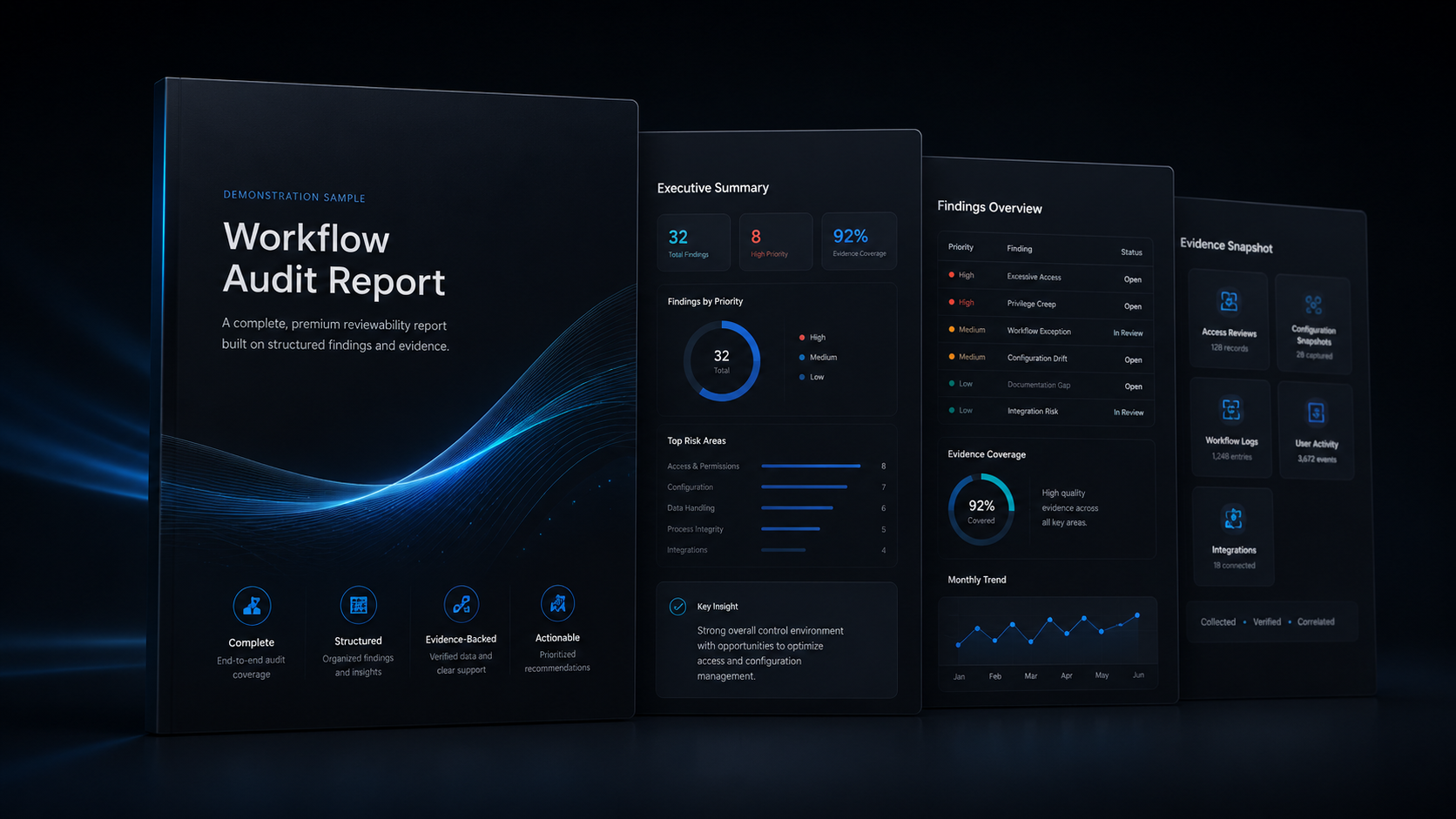
Sample workflow audit report preview showing a premium multi-page reviewability report

What you can inspect here.

You can see the full structure of the report, the scoring, the decision accountability map, the findings, the exposure estimate, and the recommended next step, in the same structure as a real engagement, but on fictional data.

  • The full structure of the report
  • The scoring approach
  • The decision accountability map
  • The findings
  • The operational exposure estimate
  • The recommended next step

How to read it

Demonstration Sample

This is a demonstration sample.

This is a demonstration sample built on a fictional client, a fictional workflow, and fictional data.

  • Fictional client.
  • Fictional workflow.
  • Fictional data.
  • Not a customer case study, not a real audit, and not a real benchmark.

All numbers are illustrative.

Inside the report.

The report structure, section by section, as it appears in a real engagement, on fictional data. To keep this sample honest, the score and grade are shown as labeled previews rather than with fabricated figures. Every section below is part of what you receive.

Demonstration Sample
Executive snapshot
/ 100
Workflow Integrity Score
Executive Grade
Estimated Operational Exposure Shown in paid report
Decision accountability map

The central spine of the report: each decision mapped from decision to reconstruction.

  1. Decision
  2. Evidence
  3. Approval
  4. Exception
  5. Record
  6. Reconstruction
Report modules, grouped

Every section you receive, organized into four clusters for easier scanning.

Executive View

  • Executive Summary A plain-language summary of the workflow, the headline posture, and the recommended next step.
  • Workflow Overview A description of the assessed workflow, its decision points, and its scope.
  • Executive Grade A single summary letter for executives, alongside the numeric score.
  • Key Risks The reviewability gaps that matter most, prioritized.

Accountability & Evidence

  • Decision Accountability Map The decision mapped across its lifecycle, from decision to reconstruction.
  • Evidence Inventory The evidence sources behind decisions, and whether they are bound and retained.
  • Approval Coverage Where approvals carry identity and rationale, and where they do not.
  • Exception Readiness How missing or invalid inputs are routed and recorded.

Scoring & Findings

  • Workflow Integrity Score A 0 to 100 score summarizing reviewability posture for the assessed workflow.
  • Scoring Breakdown The score broken down by category, with the 0, 1, 2 anchors applied.
  • Findings Snapshot The key findings at a glance, grouped by category.
  • Risk Heatmap A calm view of where reviewability gaps concentrate across the workflow.

Recommendations

  • Recommended Control Pack The recommended control pack to address the findings.
  • Implementation Roadmap A simple outline of how the recommended controls would be applied.
  • Scope and Limitations What was assessed, what was not, and the stated limitations of the assessment.
  • Estimated Operational Exposure An operational planning estimate of exposure from reviewability gaps, not a loss prediction.

How to read the report.

The structure is the same in every engagement. Read it top to bottom.

  1. Start with the executive summary and the score.
  2. See the decision accountability map and the findings.
  3. Review evidence, approval, and exception coverage.
  4. Read the operational exposure estimate as a planning figure.
  5. End with the recommended control pack and next step.

What the score means, and what it does not.

The Workflow Integrity Score and the Executive Grade summarize reviewability posture for the assessed workflow. They are derived transparently from the scoring model.

It summarizes reviewability

The Workflow Integrity Score, from 0 to 100, and the Executive Grade summarize reviewability posture for the assessed workflow.

It is transparent

The score is derived transparently from the published scoring model, using explicit 0, 1, and 2 anchors.

It is not compliance or a guarantee

It is not a compliance rating, not a guarantee, and not a market benchmark.

See the scoring model

What findings look like.

Example findings as they would appear in the report, illustrative and general, not drawn from any organization.

Illustrative Illustrative and general example findings. No named entities, no real findings.
Finding Area Impact
Approval recorded without linked evidence The approval cannot be defended on its merits later
Evidence referenced but not retained The supporting basis may be unavailable when needed
Exceptions handled outside the workflow Edge cases leave no reviewable trail
Decision records missing required fields The record does not tell the full story
Records editable without a change trail Later changes are not detectable
Approver identity not consistently captured Ownership of the decision is unclear
Automated output accepted without recorded review The human approval step is effectively skipped
Reconstruction not verified after time passes Older decisions may not be rebuildable
Exception closures lack resolution notes The handling cannot be reviewed later
Rationale not recorded with the decision A reviewer cannot follow the reasoning

What the report helps you decide.

The report is a decision-support deliverable, not a verdict. It helps you make four decisions.

  • Where you stand. Where the workflow stands on reviewability today.
  • What matters most. Which gaps matter most and should be addressed first.
  • Exposure for planning. What the operational exposure looks like as a planning estimate.
  • Whether to proceed. Whether a control pack is the right next step.

See the Insurance Control Pack

This is what a Workflow Audit produces.

The sample is the kind of report a paid Workflow Audit produces, on your real workflow and data, handled as private. Founder pricing is available, and the engagement is bounded to one workflow.

From report to controls.

When the report recommends it, the next step is the Insurance Control Pack, which addresses the findings through a structured control architecture, delivered through implementation.

See the Insurance Control Pack

From controls to an implementation path.

Implementation applies the recommended controls inside the workflow, with a 50 percent audit credit if you proceed within 30 days.

See implementation

View or download the sample.

Each option is a demonstration sample on fictional data.

  • View HTML sample

    View the demonstration sample in the browser, on fictional data.

  • Download PDF sample

    Download the demonstration sample as a PDF, on fictional data.

  • Download methodology summary

    Download an overview of the method behind the report.

These are demonstration artifacts on fictional data.

Demonstration Sample

About this sample.

  • The sample is a demonstration built on fictional data.
  • All numbers are illustrative.
  • It is not a customer case study or a real benchmark.
  • Your real audit data stays private.
  • The report supports decisions rather than guaranteeing outcomes.

Questions about the sample.

Is this a real customer report?

No. It is a demonstration sample built on a fictional client, a fictional workflow, and fictional data. It is not a customer case study.

Are the numbers real?

No. All numbers are fictional and illustrative, included to show the report structure, not real results.

Is the benchmark real?

No. Any benchmark shown is a transparent reference for the sample, not a real market average.

Will my report look like this?

Yes, in structure. A paid Workflow Audit produces the same report sections on your real workflow and data.

Is my data private?

Yes. Your audit inputs and report remain private. Only this fictional sample is public.

What is the Workflow Integrity Score?

A 0 to 100 summary of reviewability posture for the assessed workflow, derived transparently from the scoring model. It is not a compliance rating or a guarantee.

What is the Executive Grade?

A single letter that summarizes the same reviewability posture for executives, alongside the numeric score.

What is the operational exposure estimate?

An operational planning estimate of exposure from reviewability gaps. It is not a loss prediction or an insurance figure.

Is this compliance certification?

No. The report supports audit readiness and decision accountability. It does not certify compliance or provide regulatory approval.

Is this legal advice?

No. The report is not legal advice and not a replacement for internal audit or counsel.

What are the findings based on?

The sample findings are illustrative and general, not drawn from any organization.

How long is a real audit?

Typically a few business days after intake, confirmed at intake, depending on workflow complexity.

What do I do with the report?

Use it to decide where your workflow stands on reviewability, which gaps matter most, your exposure for planning, and whether a control pack is the right next step.

What happens after the report?

If the fit is strong, the recommended next step is a control pack, applied through implementation, with a 50 percent audit credit if you proceed within 30 days.

Can I download the sample?

Yes. You can view the HTML sample, download a PDF sample, and download a methodology summary, all labeled as a demonstration on fictional data.

Can I share this internally?

Yes. The sample is designed to be shared with colleagues to evaluate the deliverable.

Does the score guarantee anything?

No. The score summarizes reviewability posture from the assessment. It is not a guarantee of any outcome.

Is this specific to insurance?

The sample reflects an insurance workflow, our first focus. The report structure applies to one bounded workflow in another area when the fit is strong.

How is the score calculated?

From the scoring model, using explicit 0, 1, and 2 anchors across the scored categories. The methodology and scoring model are published.

Where do I start?

Start with a Workflow Audit, which produces this report on your real workflow.

Start your audit

See your own workflow this clearly.

You have seen the sample. A Workflow Audit produces this on your real workflow, handled as private.